
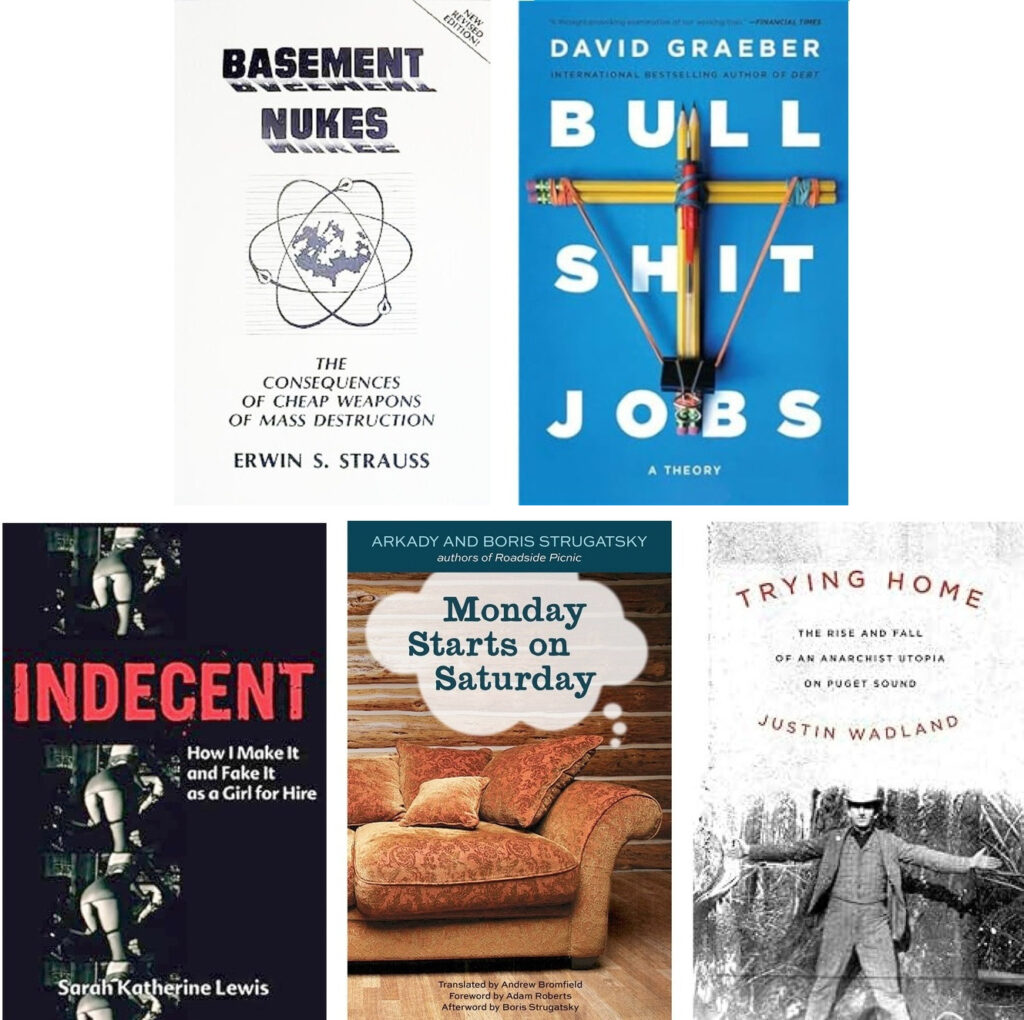
Basement Nukes
by Erwin Strauss
Disclosure up front: The author is a long-ago acquaintance of mine, an odd duck indeed but most of my favorite ducks are odd. Haven’t had any contact with him since the 1980s, but his preferred nickname was always Filthy Pierre, and Wikipedia says he’s still alive, so HELLO FILTHY if you happen to Google yourself and find this.
I bought and read this book decades ago, and to my amazement found it recently in a box of stuff left behind at my Mom & Dad’s house when I fled Seattle in 1991. Who knew Mom would keep the box at the back of her closet for all these years?
Published by the famously outrageous and long-gone Loompanics Unlimited, the book’s concept is to shock the reader, with the question of how the Cold War could unravel catastrophically when nuclear weapons become compact enough to be easily taken anywhere.
It goes into the technical specs for building a nuke the size of a briefcase or backpack, which leads to three of courses. First, of course, while the tech stuff seems well-researched, it’s over my head and probably incomprehensible to anyone who isn’t a nuclear physicist. Second, of course, anyone who does have the expertise to build a bomb wouldn’t need the book. And third, of course, these days anyone who wants to build a nuclear weapon could probably just ask ChatGPT.
More interesting than the book’s bomb-building stuff is Strauss’s predictions for what society would look like in a world of “concealed carry” nuclear weapons. Cities would be perfect targets, he thinks, so they’d be abandoned, along with the very idea of nation-states, leaving a perfect libertarian future where we’re all nuclear-armed hunter-gatherers or some such.
I read this cover-to-cover when I was maybe 25, and thought everything except the concept of smaller nukes seemed unlikely. Reading it again, I’m sure there are cellphone-size nuclear weapons now, but the rest of the book seems more unlikely than the first time
I’d read it.
My guess is, Loompanics offered Filthy the lucre, so he wrote the book, but he probably didn’t/doesn’t believe it himself. He wrote it well, though, and if the concept intrigues you, you won’t be disappointed.
Verdict: YES.
♦ ♦ ♦
Bullshit Jobs
by David Graeber
This is non-fiction, an often funny look at the myriad things people do for a living that add nothing to the world, or their employer’s productivity, or actively make both worse.
True tales of superfluous management, and people paid to answer phones that rarely ring, or to manually correct databases constantly corrupted by shitty software — hundreds of bullshit jobs are described, and it’s a list so long it could fill a book.
The author, David Graeber, was an anarchist, and it shows in the writing (which is a compliment). But after the first hundred bullshit jobs and about half the book, it felt that his point had been made, so I returned it to the library.
Verdict: YES.
♦ ♦ ♦
Indecent: How I Make It and Fake It as a Girl for Hire
by Sarah Katherine Lewis
You might remember Sarah Katherine from my zine, Pathetic Life. I sure do.
She had her own zine, Pasty, and went on to write a few books, including this one about her career as a sex worker.
Seems like not much fun as a job, but it’s a grand read if you’re not a prude. The book doesn’t go for shock, just honesty, often with a sense of humor about all the cum stains.
“Furthermore, the sad, cutout Christmas decorations taped to the walls of the arcade seemed designed to inspire holiday suicide. The customers ignored them, but I felt like the cartoon Santas and reindeer on the wall threw the smell of pee and all the unholy human degeneracy that occurred on both sides of the curtained glass into sharp relief…”
There’s an aura of intelligent snark, some scary moments, and a lot of men who seem as sad and awful as, well, a lot of men.
Never having been to the kind of places where the book takes place, it’s all alien to me, but Sarah K gives great attention to detail and fills the book with interesting characters, of which she’s the most interesting. Her co-workers are a mixed bunch, and the ‘managers’ and especially the customers are generally disgusting, and it’s 324 pages of smart and courageous writing, well worth reading.
Not much titillation, so if that’s what you’re looking for, go to a strip club and be someone’s pitiful, desperate, skanky customer.
A correction: I have always typed her name as Sarah-Katherine, with a dash. Even had a shortcut that typed it for me, back when I was typing her name frequently. Turns out she’s hyphen-free. Belated oops.
Verdict: YES.
♦ ♦ ♦
Monday Starts on Saturday
by Arkady & Boris Strugatsky
Sasha Privalov is a computer programmer who’s hoping for a quiet fishing trip with some buddies, but ends up staying at an outpost of the National Institute for the Technology of Witchcraft and Thaumaturgy (NITWiT). It’s a strange place, where the sofa isn’t just sitting there, the cats talk, mirrors do more than merely reflect, there might be mermaids in the trees, and coins re-emerge in your butt pocket after being spent.
The novel is from Arkady & Boris, the same Strugatsky brothers who wrote the trippy Roadside Picnic, which I discovered by way of the almost-as-trippy movie Stalker. It has similar surreal elements, but sprinkles the absurdity with laughs at the expense of academic egos and bureaucracy.
Maybe the translation from Russian is better than Roadside Picnic, too — I’ve re-read that book several times, and love it, but it’s an effort. Monday Starts on Saturday almost reads itself.
Verdict: YES.
♦ ♦ ♦
Trying Home
by Justin Wadland
Near Tacoma, not so many miles from where I’m living, there was once an anarchist community called Home. Its founders and residents tried to create a place truly free, with as few rules as possible.
“As anarchists, we believe that if nature’s laws are diligently studied and strictly observed, that is all that is necessary to insure man’s salvation now, and for all time to come. As free lovers we believe that individualism means that we have the inalienable, constitutional, and individual right to love whom we may, to love as long or short a period as we can, to change the lover every day if we please; and with that neither God, devil, angel, man or woman has any right to interfere.”
Sure, everyone says they love freedom, but there must be limits! Goes without saying, skinny dipping and free love cannot not tolerated in these United States.
Written more conversationally than academically, the book reads like a novel — a good one. The story jumps between the historical drama of counterculture utopians fighting pig-headed locals who wanted them all arrested and jailed, and the modern story of author Justin Wadland digging through the clues to piece their story together a century later.
I don’t remember whether he says so specifically, but the author’s sympathies are with the settlers of Home, so he’s probably a rotten stinking anarchist himself. But he’s also fair, in detailing the commune’s assorted missteps and mistakes, and demise.
It’s a depressing but still somehow inspiring story. If there was internet access, I think I’d feel at home in Home.
Verdict: YES.
3/23/2025


Leave a Reply