
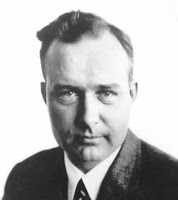
(1889 – 1944)
In his time, Thomas Midgley Jr was considered a great scientist. In retrospect, he may have accidentally killed more people than anyone else who ever lived.
Working at Delco, a subsidiary of General Motors, Midgley was tasked with solving the mystery of engine knock, a persistent ping or putt-putt sound that characterized and damaged internal-combustion engines in early automobiles.
He figured out that the knocking sound was caused by an increase in pressure and temperature within the engine cylinders, which he addressed not by recommending changes to engine design, but by altering the chemical make-up of gasoline. A mix of tetraethyl lead and bromine was added in 1921, to invent “no-knock” or Ethyl gasoline.
Problem solved!
Except… tetraethyl lead is made with lead, and lead is poisonous, and Midgley knew it. Any chemist knew it, even then. That’s why Midgley’s Ethel Corporation rarely mentioned lead in its promotional materials.
Midgley himself took an extended medical leave in 1924 due to lead poisoning, and he authored a paper on lead poison hazards in 1925.
Lead additives in ethyl gasoline were subsequently shown to be a major pollutant, causing brain and blood disorders, chronic illness, and elevated mortality. It hit children especially hard, causing lowered IQ and increased antisocial behavior.
There’s no authoritative count of how many people were injured and killed by leaded gasoline, but certainly, it was millions.
Midgley’s ethyl compounds were removed from gasoline beginning in the 1970s, as unleaded gasoline became the standard. Worldwide, the last leaded gasoline for automobiles was discontinued in early 2021.
♦ ♦ ♦
In 1928, Midgley was transferred to Frigidaire (another subsidiary of GM), where he was tasked with finding a safe, affordable replacement for the refrigerants then being used, all of which were either toxic, flammable, or both.
He came up with dichlorodifluoromethane, which is primarily a mixture of chlorine, fluorine, and carbon. Called chlorofluorocarbons, or CFCs, this compound was trademarked as Freon, and became a common component in air conditioning, insect repellents, and refrigeration systems.
Problem solved!
Except… evidence later showed that CFCs caused large-scale destruction of the planet’s ozone layer, reducing humanity’s protection from skin cancers and eye damage caused by ultraviolet radiation, and causing mutations in human DNA, and weakening the immune system. Freon leaks can also cause asphyxiation and death at higher concentrations, because its molecular structure displaces oxygen.
Again, there’s no definitive tally of deaths from chlorofluorocarbons and depletion of the ozone layer, but a lowball estimate is millions (plural).
Most CFCs were phased out by the 1980s, but Freon is still in use. It’s estimated that a few hundred people are still killed annually by huffing Freon, and CFCs continue their contributions to climate change.
♦ ♦ ♦
Late in life, Midgley contracted polio, and as the disease progressed he was confined to his home. Always a tinkerer, he designed a series of pulley mechanisms that allowed him to get from his bed to the bathroom or his home office without assistance.
Like his more famous inventions, however, this presented an unexpected danger. On a November morning in 1944, Migley slipped and became tangled in the device’s ropes, accidentally strangling himself.
10/29/2021
Republished 7/9/2023
Republished 4/4/2025


Leave a Reply