
Kongo (1932)
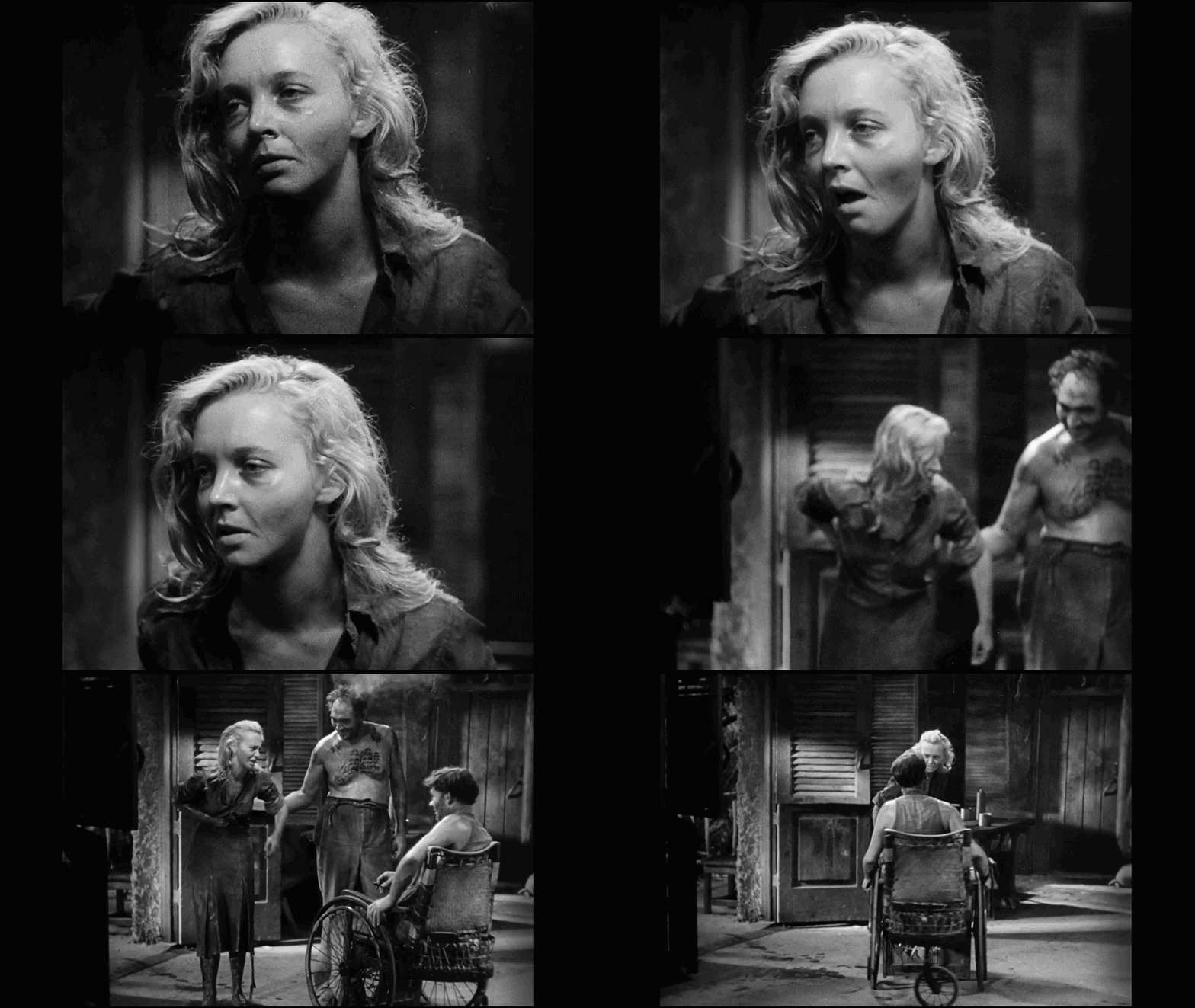
In “deepest, darkest Africa,” a drunkard and a byang-root addict help each other stand up against a cruel bastard in a wheelchair. The bastard is a former magician crippled when he was beaten by his wife’s lover, now using his magic and a supply of liquor to rule over an African tribe.
Named Flint but sometimes called ‘Deadlegs’, this bad guy violates movie rules about antagonists. He’s too bad. Like, when he laughs as he’s having a woman beaten, it’s not the familiar stage laugh of a Bond villain, “Bwa ha ha.” No, this sadistic fucker is truly enjoying it. He never has a kind word for anyone, he’s sold his own daughter into prostitution, and he’s one of the creepiest bad guys I can remember from a movie.
Walter Huston stars, the only familiar name in the cast, so I kept waiting for him to make his appearance… until I finally figured out he’s Flint, the monstrous man in the wheelchair. He looks and sounds nothing like Walter Huston in Treasure of the Sierra Madre, which was only 16 years later. Flint is young and tough and could kick my ass from his wheelchair.
As you’d expect from a 1930s American flick set in Africa, it’s loaded with racism. The tribe dances ooga-booga, wears Hollywood-style African masks, and they’re portrayed as dumber than Flint’s pet chimp. A black man is shot in the back and nobody cares, and a black woman becomes a human sacrifice (though the flick does, to its credit, show a white character who’s sincerely horrified about the sacrifice).
Kongo is pre-Code and enthusiastically lurid. The central female characters (Virginia Bruce, Lupe Velez) frequently dare their boobs to pop out of their shirts, but alas, it never happens. There’s a head-chopping scene and I’m not sure how they did it. Also not sure why Kongo is spelled with a K.
Verdict: YES.
♦ ♦ ♦
Kontroll (2003)
a/k/a Control
This opens with a rather un-photogenic man, identified as an executive of the Budapest Public Transit Company, telling the camera: “I am convinced that the viewers will… not identify the characters with our ticket inspectors, as the world in which the story is set is obviously symbolic.”
Then we ride an escalator down to the subway, where the movie remains until riding up an escalator at the end.
Bulscú is a Kontroll officer, checking tickets to make sure passengers have paid the fare. He works with a handful of other Kontroll freaks, against both fare-cheats and a rival crew of fare-checkers. Brawls or muggings could happen at any moment and frequently do. Crazies and eccentrics are among the passengers, but more among the fare inspectors, whose ‘absolute power’ underground corrupts comedically.
Yeah, this is for laughs, yet the film is so dark it’s Halloween-appropriate. A serial killer is shoving people off platforms onto the tracks, but among the movie’s numerous subplots, murder is only a minor ingredient.
Great music, gorgeous photography on trains and at platforms and on tunnel tracks, a chase reminiscent of The Warriors, and a foot race on the tracks between stations, hoping not to be splattered by the next train. It’s hilarious!
Verdict: BIG YES.
♦ ♦ ♦
The Slender Thread (1965)
Anne Bancroft has suicidal thoughts, and phones the crisis clinic, where Sidney Poitier answers. The title refers to the telephone line that connects these two, who are never in the same frame of film.
Poitier puts too much oomph into his performance, but dealing-with-headcase movies weren’t yet a familiar genre, so he didn’t have the advantage of seeing a dozen movies and TV shows about suicidal people. Bancroft is great, as always, and as with most suicidal women, her character’s problems are caused by a man who thinks he owns her.
An expert on tracing calls is brought in on his day off & doesn’t even complain about it. Sirens are everywhere, and two dozen cops are working on the don’t-let-Anne-Bancroft-die detail. I’d love to live in an America where this is the response when an anonymous voice on the phone says she’s taken barbiturates, but it’s never been that way, and certainly wasn’t in 1965.
It makes for a good movie, though. Written by Stirling Silliphant (In the Heat of the Night), based on a Life magazine article by Shana Alexander (from 60 Minutes in the 1970s). Music by Quincy Jones. Directed by Sydney Pollack, his first feature. The cast includes Telly Savalas, Ed Asner, and a glimpse of Dabney Coleman, so young you wouldn’t know it’s him.
As a bonus for me, the story is set in Seattle, and exteriors were filmed on location here and in the ‘burbs, mostly at places I recognize. There’s the University campus, the Alaskan Way Viaduct, the Pacific Science Center before it’s ongoing deterioration, and a beach on the shores of Puget Sound as the Empire Builder choo-choos past. When Anne Bancroft reads a newspaper, it’s the Seattle Post-Intelligencer (1863-2009, RIP). The climax is at the Hyatt House by the airport (1960-1989), where I had a date and a very nice night, circa 1985. There’s even a scene in a Washington liquor store, the state monopoly where government employees sold booze, after prohibition and until privatization in 2011. Make mine whiskey, please.
Verdict: YES.
♦ ♦ ♦
The Phone Call (2013)
21 minutes, set in a crisis center. Heather answers the phone when desperate people call, and one of them is Stanley, who tells her of his life as he’s ending it.
Sally Hawkins and the voice of Jim Broadbent star, and the drama is simple but universal. Zero laughs, zero yawns, with a dynamite finish only slightly marred by Carmen Phelan singing a breathy pop tune.
I would recommend this for anyone, whether you’re in crisis or not yet. And “not yet” is the best you can hope for.
Verdict: BIG YES.
♦ ♦ ♦
10/7/2026
Logo illustration by Jeff Meyer.
— — —
If you can’t find a movie I’ve reviewed, or if you have recommendations, please drop me a note. And I mean it — if you ask, I will get you the movie.
— — —
No talking once the lights dim, and only real butter on the popcorn, not that fake yellow stuff.
Leave a Reply