
Cop Hater (1957)
Someone is killing police officers in New York City, shooting ’em in the back while they’re off-duty. Investigating this, after a rah-rah pep talk from the lieutenant about law and order, the cops and detectives break plenty of laws on-screen, with the implication that they’re breaking the rest of the laws off-screen.
This is based on an ’87th Precinct’ novel by Ed McBain, and I’m pleased to mention that I’ve never read the books, and missed all the other TV and movies based on them.
The characters, good guys and bad, are dime-thin and mostly repulsive. The only thing holding my interest was seeing a few actors familiar with wrinkles without them — young Robert Loggia stars, with young Gerald O’Loughlin, and way, way down in the credits, young Jerry Orbach and Vincent Gardenia.
Verdict: MAYBE, if you like this sort of thing, but I don’t.
♦ ♦ ♦
O Brother, Where Art Thou? (2000)
I’ve seen this several times, most recently at the monthly movie with talkative family and friends where they never stop talking, all through the show. The show, though, is bonafide.
Three escaped convicts (George Clooney, John Turturro, Tim Blake Nelson) make their way across the 1930s American South, singing the blues and getting into prickly situations. It’s a good time, with Charles Durning, John Goodman, Michael Badalucco, Holly Hunter, Steven Root, and plenty of good bluegrass.
The climax is at a frickin’ Klan rally, which sure as a burning cross changes the movie’s up-til-then lighthearted attitude. It might be too soon, really, for laughing at the KKK.
Music by T Bone Burnett. Cinematography by Roger Deakins. Written by Joen & Ethan Coen, based rather loosely on Homer’s Odyssey. I’d rather see this again, than sit through Christopher Nolan’s spin on the same material.
Verdict: YES.
♦ ♦ ♦
One Battle After Another (2026)
Is this going to be a genre — films addressing political issues, available only on streaming, and starring Leonardo Di Caprio? He’s made two of them, Don’t Look Up and now One Battle After Another. Didn’t see the former, but I’ve heard it’s a satirical take on climate change. For this one, the issue is immigration and white supremacy (which is one issue, not two, if you haven’t noticed).
In the 1970s, to a very small level, lefties in America planted bombs and hoped to foment revolution. They didn’t succeed and have faded away since, and I’ll let you and whatever’s left of history decide whether that’s good or bad.
In One Battle After Another, some serious bad guys have come down on a middle-aged ex-radical (DiCaprio), and he needs to get back into the gang of bomb-planters and revolution-fomenters. Problem is, he’s smoked a lot of doobie, and doesn’t remember the secret password.
There are no American gangs of revolutionaries, of course, waiting to spring into action when the right passphrase is uttered. If there were, a famous line from the most famous poem of the 1960s might be the wrong choice for a passphrase. Hell, I knew the right response line, before the movie spoke it.
And this is a ‘me’ complaint, but I’m never gonna buy into a story of radicals and revolution in a film so obviously Big Budget Hollywood — dozens of sweeping crane shots, a fully-visualized ICE prison, beautifully-filmed car chases, fleets of police cars, gorgeous location shot after gorgeous location shot, Sean Penn overacting ridiculously, expensive rock classics on the score, etc. None of that says “Stick it to the man.”
“Inspired by” Thomas Pynchon’s novel Vineland. Co-scripted and directed by Paul Thomas Anderson (Hard Eight, Boogie Nights, Magnolia, There Will Be Blood, and too many music videos). Jonny Greenwood’s music is minimalist perfection, a piano-driven score that jumps around and heightens the “what’s next?” craziness.
What’s craziest is that DiCaprio, whom I’ve long despised, is kinda likable in this. Also, the funny parts are funny, the white supremacist parts are ugly, the tension is tense, and the movie mostly works.
Verdict: YES.
♦ ♦ ♦
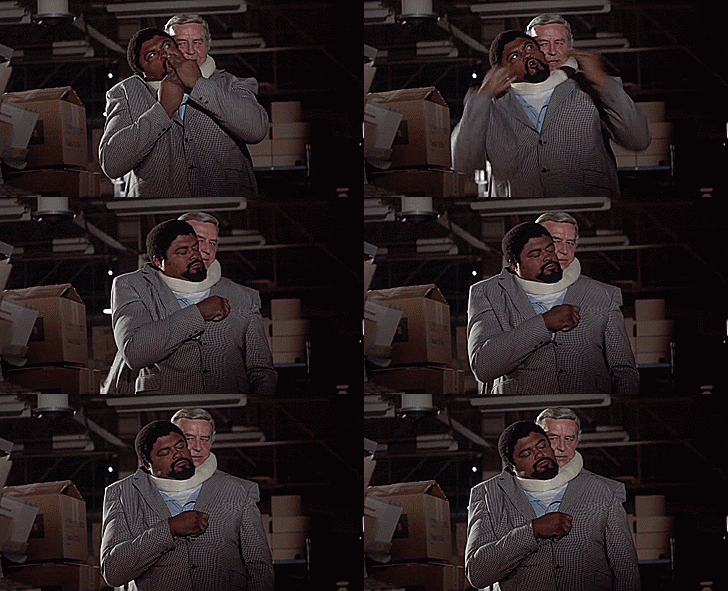
The Thing with Two Heads (1972)
News bulletin: “A two-headed man has been seen, and it is suspected that condemned murderer Jack Moss is one of those two heads.”
Maxwell Kirshner is a super-surgeon who’s dying, a problem he hopes to solve by transplanting his head onto a different person’s healthy body. Not many people are willing to be head donors, and the only volunteer is Jack Moss, a black man on death row. Doc Kirshner doesn’t like black people, but some things ya gotta do, if you’re making a mad scientist movie.
For reasons inadequately explained, the surgical process doesn’t involve removing Moss’s head and replacing it with Kirshner’s. Instead, Kirshner’s head is installed on Moss’s shoulder alongside Moss’s head, making them… The Thing with Two Heads! Neither head is helmeted during an extended motocross scene, but that’s not the film’s most glaring implausibility.
Ray Milland (Dial M for Murder) and Rosey Grier (Los Angeles Rams) star. It’s as ridiculous as it sounds, and enjoyably so.
Verdict: YES.
11/15/2026
Logo illustration by Jeff Meyer.
— — —
If you can’t find a movie I’ve reviewed, or if you have recommendations, please drop me a note. And I mean it — if you ask, I will get you the movie.
— — —
No talking once the lights dim, and only real butter on the popcorn, not that fake yellow stuff.
Leave a Reply