
THE NEVERENDING
FILM FESTIVAL #485
It’s a long bus ride from the south side to the Cinerama, which isn’t the Cinerama any more. An hour on the bus gave me time to remember the theater, so let’s start with that.
Build in 1963, it isn’t ornate like an old-time movie palace, but it’s large, just one screen with a balcony, and it has that famous curving Cinerama screen. Living in Seattle, I saw many great movies there — Spartacus and Lawrence of Arabia in 70mm, The Great Escape, Wargames. All the few ladies I dated in the 1970s and ’80s sat beside me for movies at the Cinerama. Once, during The Exorcist, there was hanky-panky.
All good things come to an end, and eventually some chain bought the Cinerama, let it fall into disrepair, and closed it. Then it was rescued by Microsoft billionaire Paul Allen, who fixed it up nice again and ran it at a loss because he loved old movies. Then he died, and the theater was shuttered again.
SIFF (Seattle International Film Festival) bought the venerable old place a few years ago, and had to change the name, because Cinerama is a trademark of Pacific Theatres, which owned Seattle’s Cinerama when it was first built.
All of which means I was headed to see Ken Russell’s The Devils at what’s now the SIFF Cinema Downtown. It would be my first movie there in at least 35 years.
And I’m not wild about SIFF. With the success of their annual film festival, they’ve purchased several local theaters, which are run rather blandly, with the priciest admissions in town. SIFF closed The Egyptian, a place I loved, at least partly because owning the former Cinerama has pinched their profits. The Uptown, which is the SIFF I usually go to, requires employees to chew gum, keeps the auditoriums uncomfortably cold, and I once had to step out of a screening to remind staff to dim the houselights.
I assumed the Cinerama would be run the same disinterested, chain-like way, and indeed, the person in the ticket booth could have a brilliant career at DMV. I had to say “one ticket” three times, before she swiveled a screen toward me and said, “Choose a seat.”
I hate choosing a seat at the booth. There’s no advantage to it, compared to the old-fashioned way, walking in and simply sitting where you choose.
“Balcony,” I said, and she clicked a button, printed a ticket, handed it to me, and went back to the book she was reading. On the upside, I’d come on a Tuesday, when all flicks are just $7, instead of the usual $18 or $20.
Inside, an older woman was the ticket-taker, and seemed very nice for our five-second interaction. She even said “Thanks, enjoy the show.” When I buy the place, that lady can keep her job.
At the concession stand, I said, “Red Vines,” and a male employee said, “Six dollars,” which was the entirety of that conversation. His body language and attitude added, “Go away please.”
To ready myself for sitting through a film without interruption, I needed to pee, and even all these decades since the last time I’d been there, I remembered where the restrooms are. To my amusement and approval, they’re no longer men’s room and ladies’ room. Instead they’re both unisex, marked “Toilets and urinals” or “Toilets without urinals.” Very 21st Century, and I hope it keeps Republicans away.
Being old with a bad knee, I needed the elevator for a ride to my balcony seat. The elevator’s buttons are ‘1’, ‘2’, and ‘3’. ‘1’ is street level but unmarked, ‘2’ is the main auditorium, and ‘3’ is also unmarked, but presumably rises to the balcony. The ‘3’ button did nothing, though. The only working choices were ‘1’ and ‘2’.
I pushed ‘2’, the elevator took me there, but to reach the balcony, stairs awaited. With moderate pain, I climbed a flight and walked inside, but this wasn’t the balcony, just the back rows of the main auditorium. In the hallway again, were stairs to the balcony. At least two flights up, then maybe more stairs I couldn’t see. My knee said to settle for the main auditorium, so I did, and picked a seat.
The theater is in good condition. The seats are old-school and old, reasonably comfortable but without the modern ’tilt’ function. And I hate the modern ’tilt’ function, so that’s cool. Speaking of cool, the theater wasn’t uncomfortably cold, and the Red Vines weren’t stale.
I’d estimate the crowd at about 200, but the theater is huge, and more seats were empty than taken.
A few minutes after I sat down, a man sat two seats from me in the same row. What the fuck? Nothing but emptiness stretched across several adjacent rows, but then I remembered — assigned seating. He was probably where he was supposed to be. I was the person who wasn’t.
A slideshow of ads was underway, but it was bearable – they were ads for local businesses and didn’t include a sales-pitch soundtrack. And the lights were still on, allowing me to scribble all this in my notebook.
After 20 or so ads, a young man approached holding his ticket, and said not-meanly that I was in his seat.
As I was getting up I said, “I’m supposed to be in the balcony but it’s closed,” though probably it wasn’t closed, just closed to patrons with a bum knee.
My next selected seat was a few rows further back, and there were no further relocations. The slideshow ended, the lights dimmed, and the video ads began.
Thankfully, it was just one paid ad, then three short shorts for how great SIFF Cinemas are. Next came the coming attractions, which are also ads, but I enjoy trailers. Five movies were hawked at the audience, of which one (ClubKid) looked good, and one (Paper Tiger) looked like the movie might be good, though the trailer sucked.
Finally, 15 minutes after the listed showtime, the movie began.
The Devils is set in the French city of Loudun, in 1634, amidst the stinking deaths of the Plague. The opening screen announces that the story is true, that these characters all lived and breathed, and then three plotlines unfold.
In the first, Father Grandier (Oliver Reed) is “the most beautiful man in the world,” and always has at least one affair going on. He gets a goth girl pregnant and abandons her, which infuriates her father, who comes looking for vengeance.
In the second, a hunchbacked and wild-eyed nun, Sister Jeanne (Vanessa Redgrave), is tortured by witch hunter Father Pierre Barre (Michael Gothard), and falsely accuses Grandier of defiling her.
In the third and most complicated storyline, Cardinal Richelieu (Christopher Logue) manipulates a kooky King to topple the walls that keep the city of Loudun safe and mostly independent, and encourages a show trial of Father Grandier after Grandier opposes the toppling. And yes, that’s Cardinal Richelieu from The Three Musketeers. He was a busy guy.
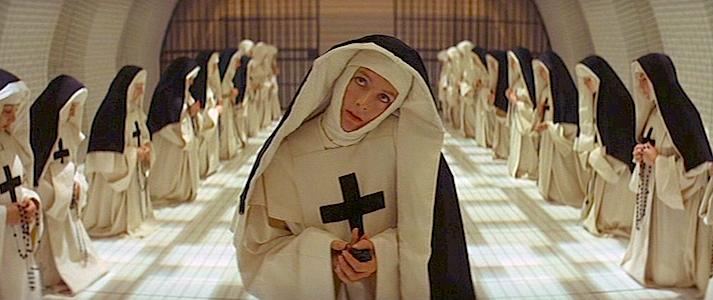
If my telling sounds dull, the movie is anything but. It’s written and directed by Ken Russell, master of visual excess, and it’s mesmerizing, disgusting, angry, funny, intelligent, and has something to say.
Unfortunately, latecomers also had something to say. “This is row K, seat 9.”
“No, it’s row L!” someone else corrected.
As it was too dark to see the tickets, out came a cell phone’s bright lantern function. The audience booed, the argument continued, the light thankfully went off.
The theater’s main floor has too slight a slope, so these people, a dozen of them one or two at a time over about twenty minutes, were silhouetted against the screen like MST3K, only walking instead of seated. “Mumble, mumble, shh shh…”, then silence, then another latecomer.
This might be why, decades ago, I’d always beelined for the balcony at the Cinerama. In the balcony, people walking the aisles are below your line of sight. But the balcony was forbidden, so I saw all of them, and reserved seating makes the problem worse. Latecomers can’t simply find an empty seat and sit, they must identify and perhaps argue about what seat it is, and whether it matches the printed ticket.
When all the distractions had found their seats, my attention returned to the film. Which was, I should mention, pristine. No scratches, no glitches, no crackles on the soundtrack.
Reed’s Father Grandier is so vain and cruel, I thought he was the bad guy until the other plots kicked in. Turns out, once Richelieu and the witch hunter and two torturing doctors and the frightful baby-faced Baron De Laubardemont (Dudley Sutton) show up, plus a few further mid-level tyrants, Grandier, vile as he is, might be the noblest character in Loudun.
The film’s imagery is intense, ferocious, relentless. Crucified blasphemers are left to rot on circular crosses. Dozens of chained men are forced to walk in a ginormous hamster wheel. Infinite corpses from the Plague are piled and torched. The king goes ‘bird-hunting’ by shooting at men dressed as birds. And then come the torture-filled blasphemy trials, involuntary pressure douching, and nuns and parishioners driven by religious ecstasy to orgiastic sex.
This may be the most debauched film I’ve seen, excluding plain pornography, and yet it has heart. For all its horrors, it is beautiful. None of what I’ve described is as uncaring and inhuman as any of the many vapid screaming deaths in a modern horror movie.
“No blood, though his tongue was pricked. True sign of the Devil,” one of the torturous doctors dictates to a record-keeping scribe, after the other doctor stabs at Grandier’s tongue and blood spurts out.
Later, as he’s tied to the stake and the flames are lit, townsfolk dressed in their finest duds cheer on the execution. And yet, Mr Russell finds a happy ending, which I shall not reveal.
The film is beyond excellent, one of the best films I’ve seen, period, despite the latecomers and lack of balcony access. If you have a chance to see The Devils you certainly should, and Seattle’s Not Cinerama is an OK place for watching it.
On my long ride home afterwards, there was much to be pondered, and two days later, I’m still pondering.
As it played, I’d thought it was remarkably anti-religious. There is rarely a moment when the church doesn’t come off awful, because, as mentioned earlier, it’s a true story. It could be subtitled, “This is the Catholic Church.”
The Devils, though, is not anti-religious so much as anti-authoritarian. It’s showing the result, when any man is given absolute power. Stephen Miller and Pete Hegseth and their cohorts would take us to the film’s city of Loudun under a different name, but bring back all the torture and cruelty and hypocrisy. They’d do it with religion if religion is handy, but if not they’d do it all the same.
11/5/2026


Leave a Reply