

NEVERENDING FILM FESTIVAL
#358
January 14, 2025
My pledge to you:
Only the basics of a movie’s premise, with no spoilers.
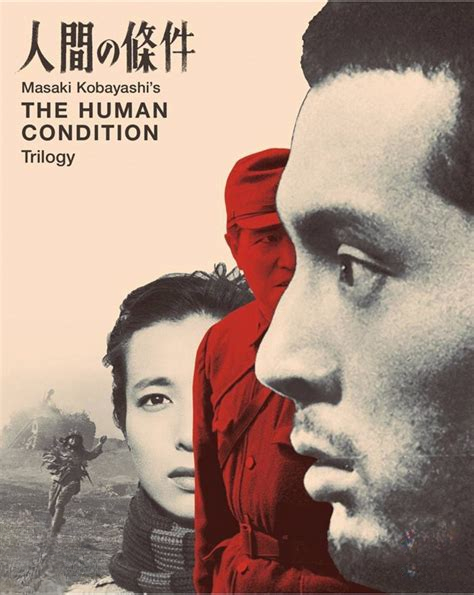
The Human Condition I:
No Greater Love (1959)
The Human Condition II:
Road to Eternity (1959)
The Human Condition III:
A Soldier’s Prayer (1961)
Buckle up, bub. This defines or defies what movies are. It’s bigger than ordinary descriptive labels like ‘war movie’, ‘prison movie’, ‘political movie’, ‘historical movie’, ‘art movie’, ‘foreign movie’. It’s all those things and very good at all those things, but it’s way bigger.
Most obviously, it’s bigger in scope and length. It’s three movies, each of them around three hours long, so this is a 9½-hour commitment, which I never regretted for an instant. Watched the whole shebang twice, actually. It was terrific the first time, and better the second time.
I’m also struck by the artistic accomplishment, which sounds like I’m some highfalutin cinema connoisseur, which I ain’t, but holy crap — 9½ hours without yawns, with astounding photography, sets and scenes that seem filmed on location in World War II, ample intellectual content, plus all the frustrations you’d expect from something called The Human Condition.
As the story begins, Kaji, the central character, is a rather bookish academic who doesn’t think highly of the war or the military, but he’s Japanese so he expects to be drafted soon. There’s a touch of pinko or pacifism about Kaji, who believes that people should be treated with respect, even in prison.
At university, he authors a study concluding that Japan’s wartime slave-labor camps in China would be more efficient, the mines would produce more ore, if the prisoners were fed better and beaten less. Radical, I know!
For this he’s granted an exemption from military service, but with a catch — he’s sent to occupied Manchuria, to act as civilian supervisor at one of Japan’s prison camps. There, his idealism meets the military’s entrenched bureaucracy and brutality — nobody else wants to change the way the prison is run, and even the slightest improvement is a struggle.
In the second film, Kaji is drafted into the army, but suspected as a red, so all the officers at boot camp keep a doubleclose eye on him. Training is almost as brutal as the prison in the first movie. Anyone who doesn’t follow orders instantly or falls a step behind in the marches gets beaten about the head by a higher-ranking officer. Even the supervising nurse at a hospital slaps the patients around if they get out of line. There are more head-punches here than in the original Rocky.
Kaji earns a promotion, to be drill sergeant for new recruits, but he’s still idealistic, and wants to avoid the ordinary cruelty. And again, there’s stubborn resistance. When training comes to an end, the principled soldier Kaji is sent to the front, and the last movie-and-a half is a war-movie-and-a-half.
I don’t like war movies. This is a terrific war movie, though, set in a war that’s already almost over — the Japanese are on the verge of defeat. Kaji’s tiny squadron of raw soldiers have barely been issued their rifles, when they’re up against a fleet of twenty Soviet tanks.
Through it all, Kaji tries to remain true to his beliefs, but that’s near impossible in a war. A bad situation becomes worse, becomes intolerable, and you can sure see how a good person becomes subservient to evil all around him.
“Kaji, you called me a fool once. I won’t forget that. You also saved me from those tanks. I won’t forget that either. What kind of guy are you anyway?”
I’m struck, especially on watching these movies a second time, by how believably naïve Kaji seems at the beginning, and how believably weary he seems at the end. Dude’s been forced to do a lot of things he never wanted to do, yet he keeps trying to be decent.
What is the human condition, if not trying to rise above it? More than the story of a man or even a war, this is a story of one guy trying to evolve a little.
Most unusual, and more than almost any movie I can remember, it’s about ideals — from humanism to patriotism to socialism, from love to the famous Japanese code of honor. And it’s subversive as hell, giving all those notions the Hindenburg treatment, again and again. It comes to a conclusion I hadn’t expected and won’t even hint at, but it’s satisfying and appropriate.
“Long live the Japanese Empire!” someone shouts midway through the second movie, and immediately gets shot dead.
Verdict: BIG YES. Bigger than that.
♦ ♦ ♦

The Human Tornado (1976)
Dolemite is tough guy character invented by comedian Rudy Ray Moore. In his stand-up act, Dolemite was supposed to be funny, and maybe it was, but in the films — this is a sequel to 1975’s Dolemite — it’s taken sorta seriously. I guess?
There’s no particular plot to be found, most of the action is sped-up slapstick style, and the comedy is on a Three Stooges level plus tits, motherfuckers, and fuck you. But it’s just dumb enough to enjoy, while wondering what dumb thing will happen next.
Verdict: YES.
♦ ♦ ♦
Human Zoos (2018)
A century or so ago, a very few pygmies and Africans were housed in American zoos, displayed like animals. This was considered ‘science’, and endorsed by leading museums and scientific organizations. This is a documentary about that, and it goes without saying that the history is frightful.
Unfortunately, the movie’s arguments and style start seeming off to me about halfway through, when it wanders into the history of forced sterilizations in America, and racism in general, and how Darwin’s Theory of Evolution has been grasped at and used to fuel racism. These things happened and still do, but the movie is obviously swinging for a larger target than humans displayed in zoos.
And indeed, the closing credits reveal that Human Zoos was sponsored by the Discovery Institute, a right-wing ‘think tank’ that’s mostly about denying Darwin and pushing the nonsensical ‘intelligent design’ — God.
Wouldn’t have watched this if I’d known that, which is exactly why it’s unmentioned until the closing credits. That said, the scientific history presented seems sound. Just, consider the source.
Verdict: MAYBE.
♦ ♦ ♦
… and out of alphabetical order …

The Atomic City (1952)
Dratted commies have kidnapped a painfully well-behaved perfect American boychild, and the ransom they’re demanding isn’t money — it’s nuclear secrets. The boy’s father works at the Los Alamos nuclear labs, and has top super-dooper classified info in his head.
Set amidst the Manhattan Project, this is a pretty good thriller, so long as you can avoid all the nutty patriotic assumptions built into it.
For example, anyone coming in or out of Los Alamos — the entire city, not just the facility — is forced to answer questions at a check station, and their vehicles are searched. Everyone in the area is accustomed to this, and to being shadowed by G-men. It’s unquestioned in the movie; necessary, for national security.
It was a crazy time, but of course every time in America is a crazy time. My gut says, if this is what it was like for ordinary people living near the Los Alamos facility, why pretend they were defending the American way of life, when everyone was forced to live the USSR lifestyle?
Less outrageous and more Hollywood, some of the movie’s intrigue takes place at a baseball game, in Los Alamos. It was filmed in an old-time major league or upper-minor league stadium, with about 10,000 people packing the grandstands. Being a recovering baseball nerd, I looked it up, and the entire county of Los Alamos had a population of 10,467 in the 1950 census, with no minor league baseball.
But again, all quibbles aside, The Atomic City is a workable thriller.
Verdict: YES.
1/14/2025
Coming attractions:
Hummingbird (2013)
The Hunchback of Notre Dame (1923)
The Hunchback of Notre Dame (1939)
The Hunger (1983)
… plus schlock, shorts, and
movies out of alphabetical order…
Logo illustration by Jeff Meyer.
No talking once the lights dim, and only real butter on the popcorn, not that fake yellow stuff.


Leave a Reply