
— MAYBE —

A shirtless architect enters into a big-money real estate deal with Angela Lansbury in a swimsuit, who’s 40 years younger than you might remember her.
♦ ♦ ♦
Blow-Up (1966)
— YES —
A fashion photographer on a photo-shoot in a park discovers — later, when he’s developing the pictures — that he’s accidentally snapped a murder as it happened. This is a gorgeously made movie, by Michelangelo Antonioni, set in 1960s mod London. Everyone says it’s a classic, and everyone’s right, but it certainly wasn’t what I expected.
David Hemmings plays the photographer, as an insufferably arrogant prick. He has no sense of humor, believes he’s An Important Artist though he’s Definitely Not, and seems to hate the models he’s taking pictures of. I don’t think there are any women in the movie that he doesn’t treat shabby at best. The misogyny is frustrating, but that said, it’s probably an accurate portrayal of a big-time fashion photographer in the mid-1960s, and it’s not the movie’s driving force.
 Actually, the movie has no driving force. It wanders casually and repeatedly off-topic — there are mimes, fer chrissakes, and ridiculously long photo-shoot sessions that have nothing to do with the story. There’s an irrelevant stop in an antique store, a propeller delivery, and several literal walks in the park.
The movie runs almost two hours, and I’d guess the actual plot takes about 25 minutes of that time. So it’s a mess, and even when it’s over, it refuses to make sense.
— BIG NO —
• A hospital won’t sedate a patient and then discharge her while she’s still groggy, and discharge her to the custody of a man not related, so he can take her to a hotel while she’s still sedated.
• A big-time political operative might tell Travolta to keep quiet about what he’s seen, but it wouldn’t be said so very nicely.
• A car that a prominent politician drowned in, once dredged from the river, would not be parked in a back alley outside the police crime lab.
• A glossy magazine can’t be printed and distributed overnight.
• A one-car wreck on a deserted street late at night is audio-recorded by Travolta, OK … and it’s also filmed by some random videographer?
• And we’re supposed to believe John frickin’ Travolta was “the kind of kid who won all the science fairs”?
• Inside the movie’s world, there’s a low-budget horror movie being made, and the director and sound guy spend lots of time auditioning and recording and re-recording the sound of assorted women screaming, to get exactly the right scream. I’m seriously skeptical.
• And lastly, Nancy Allen is the movie’s co-star, and I’ve usually liked her work, so I’ll blame the script more than her, but the character she’s playing is so stupid she belongs on the list of the movie’s wildly implausible ingredients.

♦ ♦ ♦
The Martian (2015)
— BIG YES —
Andy Weir’s novel The Martian is a kickass page-turner about an astronaut stranded alone on Mars. This movie adaptation, directed by Ridley Scott and starring Matt Damon, is a Hollywood flick with a huge budget behind it, so there would be no excuse if it was anything less than an excellent thriller.
No worries, it’s an excellent thriller.
— MAYBE —
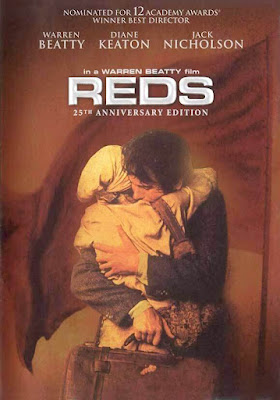
The subtitle here could be “Lovable leftists in love!” It’s the true story of early-20th century writers and revolutionaries John Reed and Louise Bryant. I’d never heard of either of them, but Google tells me they were real people.
An all-star cast of actors play famous people I have heard of, including Jack Nicholson as Eugene O’Neill, Dolph Sweet as Big Bill Haywood, and Maureen Stapleton as famed anarchist Emma Goldman. Other movie stars play other people who might have been famous, too, but I watched this movie only as a movie, and did not follow-up with hours of research, so they’re just movie stars to me — Gene Hackman, Paul Sorvino, M Emmet Walsh, maybe more.
It’s bizarre (and so rare I can think of no other examples) to see something akin to my politics in a Hollywood movie. There’s anti-war sentiment, anti-capitalism, and even IWW calls for “one big union.” Not really what you expect in a movie, well, unless the movie is called Reds.
Under the political veneer, it’s a realistically rocky romance between two strong-willed and complicated people — Warren Beatty as Reed, Diane Keaton as Bryant — who struggle to live up to their important ideals, as do we all. Beatty is good, but I doubt he’s really playing Reed; the character seems more like Warren Beatty. Keaton is good, too, but her character is basically Annie Hall, and Nicholson’s troubled writer is just a rerun of his Jack Torrance from The Shining.
Until the intermission, it’s a pretty good flick — huge, bloated, but entertaining. After intermission, the movie becomes something of a slog through political squabbles between American leftists, and into the ugly realities of what happened after the Russian revolution. Reed is a red, so eventually he’s drawn to the revolution as more than merely a journalist, and soon he’s on a stage rousing the Russian rabble.
Overall, it’s disappointing, but it’s hard to say whether I’m reviewing the movie or the history it’s telling. Maybe both are disappointing.
Beatty, who also wrote and directed and produced Reds, gave it everything he had, and it’s a major-league epic. But now I have the Commie anthem “Internationale” stuck in my brain, and while I’m no damned capitalist, we’re certainly lucky that nothing like the Russian Revolution — and what came after it — came to America.
The high point of the movie, for me, is a brilliant extended writing montage, with Reed and Bryant at their typewriters and at each other, editing, criticizing, and each making suggestions about what’s weak in the other’s work. Maybe that’s personal for me, though — I’d love a collaboration like that.
When the movie first came out, a friend told me he’d walked out of the theater, not because of the politics but because he got tired of all the old people on-screen talking about old memories, and occasionally breaking into folk or political songs. Indeed, the movie’s sweeping yesteryear adventure is repeatedly interrupted by old folks being interviewed about their memories of Reed and Bryant. I liked the old talkers, though. Liked ‘em when I saw this movie in the ‘80s, and still liked the old timers when I watched Reds again last night.
I wasn’t going the mention the obvious, that a movie this epic and opulent must’ve had Big Money behind it, until I noticed in the end credits that the whole shebang is © MCMLXXXI by Barclays Mercantile Industrial Finance Limited. A bank, not a movie studio, literally owns this movie.
Also, in a strange product placement, Reds has at least two mentions of Chase & Sanborn brand coffee, which everyone in the movie agrees was great coffee in a can in the 1910s, so let’s explore the capitalism of that: Since the time of Reed & Bryant, Wikipedia says Chase & Sanborn has gone from being an independent company to being a subsidiary of Standard Brands, then Nabisco, then General Coffee, then Hills Brothers, then Nestle, then Sara Lee, and it’s currently made by a conglomerate called Massimo Zanetti. With a pedigree like that, I’ll wager the coffee tastes like hot piss.
♦ ♦ ♦
— YES —
 This stars James Spader, and Kurt Russell with a ridiculous crew-cut, in a mystery about who really built the pyramids.
Some ancient artifacts that must mean something blah blah blah, and Spader is the only person who can make sense of it all. The story eventually takes us to another planet, where we meet Ra the sun god.
— YES —
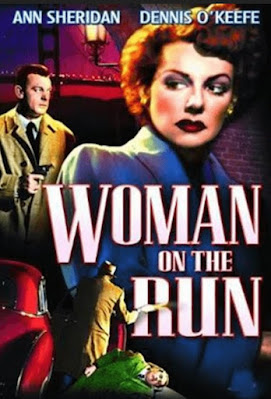
It’s one of those movies you’ve probably never heard of, but afterwards you’ll say, Damn, that was great! Why haven’t I ever heard of this movie?
The main cop makes some sexist wisecracks, which seems appropriate, since he’s a complete prick in other ways too. A cop who’s a prick can only make any movie seem more realistic.
Woman on the Run was filmed on location in Frisco, which adds to the charm, at least for me. Memorable moments include the skylight escape, a kiss on the sidewalk, the philosophical conversation in the cab, and “Shut the door as you go out.”
10/28/2021


Leave a Reply