
It was nothing personal — I never met the guy. It wasn’t political, either — I don’t remember his politics, and had no politics of my own yet. He was the mayor, and I didn’t like him, that’s all.
Mostly I didn’t like Charles Royer because he had been a local TV reporter. You know the look — handsome, hollow-headed, blow-dried hair, fake gravitas. Decades have passed and TV news has only gotten worse, more superficial, but there’s probably a ‘Charles Royer’ in your town, or three or four of them. Young or youngish, white, nice necktie, deep voice, shallow thoughts. It got him promoted to the anchor’s chair for Channel 5, the NBC affiliate in Seattle.
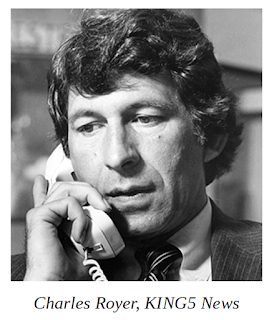
I can’t find a picture of Royer behind the anchor’s desk, but here he is in a publicity pose, pretending to talk to someone important on the phone:
Royer wasn’t satisfied with his career trajectory in teevee journalism, so he quit the anchor job to run for mayor, which annoyed me, on two fronts: First, it puts the lie to ‘impartial journalism’, when a reporter goes directly from “just the facts” to being a candidate and having opinions on every issue. And second, Royer had never held any elected office or managed anything, not even a 7-Eleven. But he won the election, parlaying his local fame and high ratings to leapfrog over more experienced candidates.
My employer at the time was Virginia Mason Medical Center, offering swanky and high-priced medical care for patients with big money. Charles Royer was a patient of the clinic, so I had access to his home address. I worked in the billing office, doing data entry that sent patients their bills, and knew the software well enough to monkey with it.
How could I not do this?
It was long before the internet, so I visited the downtown library, did some book-research, and then came into the office an hour early one morning, to accomplish my mission. I coded and input a series of medical events for Mayor Royer — hormone therapy, surgical removal of testicles and penis, sculpting and installation of a vagina, and breast enhancement. I hadn’t been able to find much info on the cost of such work, so the prices were pulled outta my butt. The bill came to something like $95,000, I think — maybe that was a bargain?
Then I printed a billing statement for Mayor Royer, slipped it into an envelope indistinguishable from that morning’s hundreds of other outbound mailings, and, of course, deleted all records of my prank.
A month later, I created a follow-up bill, marked it as “past-due”, and mailed it again. After that second mailing, though, it seemed unwise to mail it a third time, so the story ends there.
Goes without saying, it was childish, stupid, and would now be considered trans-unfriendly and a violation of patient privacy. On all counts, I plead guilty and apologize.
But also, gimme a break — I was 19 years old, just a dumb kid, and he was Charles Royer, so he deserved it.
For a punchline or payoff, all I’d wanted was to hear that the mayor, or someone on his staff, had called the clinic and been furious. My desk was within earshot of the billing help-lines, so I had hoped to actually overhear that call, or at least be told about it soon after the fact, but no such luck. Even in that pre-HIPAA age, the clinic had strict confidentiality rules, so nobody talked much about who’d called or why.
A few weeks after the second mailing, though, I opened the mayor’s billing record, and saw that someone on his staff had phoned the clinic. The employee’s notation said something like, “Patient’s secretary inquired about a bill for an operation, but I see no such records, and told her not to be concerned.”
The statute of limitations passed on this long ago, so today I’m sharing the story. Wish it had a better punchline, sorry. The only smart thing in all of it was not sending the bill a third time.
10/15/2021
Republished 3/26/2025


Leave a Reply