
One fine day in the 1970s, I walked into a new bookstore near my apartment. The sign only said “Eclectic Books,” but to my surprise, it was almost all porn.
Nothing wrong with that, and I made a mental note to come back later, but I’d been looking for something to read, not wank material. Behind a curtain of shame in the back corner, the shop had a small selection of literature, too — few classics like Twain and Ulysses, and some current bestsellers.
Hmmm, here’s a book I’ve never heard of before, never heard of the author either, but the blurbs on the back were all raves, and the first few paragraphs held my attention, so I bought it.
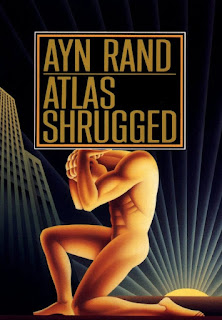
Atlas Shrugged, by Ayn Rand. All I’d wanted was a book to read, but five minutes in that porn store changed the trajectory of my stupid life.
♦ ♦ ♦
The opening line of Atlas Shrugged is, “Who is John Galt?” Turn away now if you want no spoilers, because I’m going to answer that question.
In the novel, John Galt is a brilliant gazillionaire, and the first of many gazillionaires and high-powered business-people who go on strike. They refuse to do their “millionaire and high-powered business-people” work. However will the world survive without them?
Galt and the other big-money titans in Ayn Rand’s world think like this: You dare to regulate my business? You expect me to pay taxes? Why then, to hell with you — I shall take my magnificence to some remote place beyond the reach of your puny government, and leave you sniveling fools to fend for yourselves. Bwa-ha-ha!
I read the book over the weekend at work, and loved it. It’s full of arguments where the good guys are all basically Ayn Rand, and everyone who opposes Rand is an idiot, so she wins every argument. And she certainly won me over. I was alienated, lonely, and politically a blank slate, so Atlas Shrugged made me a libertarian.
♦ ♦ ♦
“Libertarianism” is what Rand always advocated — freedom for all, but especially freedom for the rich and powerful. Who wouldn’t want to be rich and powerful and free?
I joined the local Libertarian Party, carried placards at protests against taxation, wrote libertarian pamphlets and zines, and sat on the planning committee for the big Libertarian convention. I squeed like a fanboy when I met libertarian big shots like Ron Paul and Murray Rothbard. I bought a cassette of libertarian pop music, and played it until the tape wore down and snapped, and then I bought another copy.
Libertarianism was the answer to everything, I thought, though my core beliefs never went much further than the basics — pot and prostitution should be legal. That’s the starter kit, and it’s certainly appealing.
Pot should be legal, libertarians say, because it’s your body, and your choice what you put in it. Prostitution should be legal, for much the same reason. I believed that then, and still believe it now.
Beyond that, though, libertarian theory gets thorny, difficult to explain and tricky to justify. Many libertarians argue for legalization of all drugs — cocaine, heroin, PCP, and whatever concoctions you cook and sell. They should all be on the shelf at 7-Eleven, alongside any and all prescription drugs, because what’s a ‘prescription’, really, except someone telling you what you can (and can’t) imbibe? That’s an affront to freedom.
Many libertarians believe there should be no driver’s licenses, no marriage licenses, no fishing licenses, and no requirements for a license to practice medicine or law, fly a plane, pull or fill teeth, build houses, embalm corpses, etc. Whatever you want to do for a hobby or for a living, you should be free to do it. By what right does anyone tell you you can’t perform open-heart surgery? That’s an affront to freedom.
The Civil Rights Act was a mistake, according to many libertarians. A motel’s owner should decide who they will and won’t welcome, and a restaurant should be free to refuse service to anyone for any reason. If
states choose to enact a poll tax, or require voters to first pass a stringent test, what’s wrong with that? States’ rights are more important than any black person’s right to vote. Or so the libertarians
say.
“Taxation is theft” was an ever-present theme, and always available as a bumper sticker or t-shirt. Libertarian thinking was and is, you never signed a contract agreeing to pay taxes, so you don’t owe taxes.
Someone’s hungry and has no money? Tough shit. People who don’t have money should work harder. Food stamps, Medicare, Social Security, and other aid programs should be dissolved. Whatever need anyone has for such services can be met by charity, not by government, since, after all, government only gets its funds by stealing them. Taxation is theft, remember.
Greed and selfishness are good, because they motivate people to create more and new and better goods and services and products and inventions.
Selflessness, kindness, or anything that doesn’t earn a profit — like a fire department, or aid programs — are simply parasitic. Such services shouldn’t exist unless they’re 100% privately funded, and if they
are, don’t expect a donation from a libertarian.
All businesses should be completely deregulated, many libertarians say. Nobody should inspect a bank’s bookkeeping, a car company’s safety record, a restaurant’s kitchen, or a factory’s machinery or working conditions. Muh freedom!
The nonsense never ends. I don’t remember any libertarian acquaintances who advocated that businesses should turn away black customers, should refuse to hire women, should require that employees profess Christian faith, or that parents should abandon their children, that people should fuck children, dogs, or corpses, that you should sell yourself into slavery, or you should kill your neighbor if he plays music too loud — but libertarians love discussing such concepts ‘academically’. Basically, “I wouldn’t do such things, goodness no, but you should be free to, if you wish.” That’s the libertarian ideal.
I hung out with libertarians for years, maybe because most of them were alienated and lonely like me. We had each other — a bunch of alienated lonely people in the same room — and amplified each others’ nuttiness. Curiously, in my time with the libertarians, I never met a rich person at any of our meetings. Hmmm.
♦ ♦ ♦
There was no dramatic moment of leaving the libertarians, but gradually I understood that their fetish for freedom wouldn’t, shouldn’t, and literally couldn’t work in reality. Much older and a little wiser, I’d now say:
Taxation is a fair way to provide for the public good. Capitalism without regulation is serfdom with suits. Being rich doesn’t mean you deserve to be rich, and probably means you were lucky or criminal, not that you’re better or smarter than anyone else. “Work harder” is not a viable solution for everyone who’s having tough times.
Some people need a helping hand, and that’s the job of a good government. Someone ought to protect ‘little people’ from the power of ‘big people’ and giant corporations. Maybe giant corporations shouldn’t exist.
By all means, let the pot-smokers out of prison and the hookers out of jail. Beyond that, libertarian ideals are a celebration of cruelty and the opposite of a society. We ought to be better than that.
I read and re-read Atlas Shrugged a dozen times, but the last time I tried — perhaps 20 years ago — it seemed so ignorant of what humans are, I couldn’t take it seriously.
“Who is John Galt?” He’s a fictional bastard who believes he’s more important than his entire society, nation, and world. If he can’t have everything his way, then to blazes with everyone and everything.
John Galt doesn’t exist, but if he did he’d be just another Jeff Bezos, Elon Musk, or Mark Zuckerberg. Such men aren’t the heroes of any book worth reading, and their ‘philosophy’ is stupid, cruel, and greedy.
Eat the rich, and burn Atlas Shrugged.
11/2/2021
Republished 4/8/2025


Leave a Reply